
The Alchemy of Becoming
What Medieval Gold-Seekers Knew About Becoming Human

This morning, coffee in hand and watching the light change outside my window, I found myself thinking about alchemy—that ancient, pre-scientific pursuit of transforming base metals into gold. Most of us dismiss it as medieval wishful thinking or the topic of a book we’ve hear of. But Carl Jung saw something deeper.
In Richard Rohr's latest book, The Tears of Things, he unpacks Jung's radical reframe: "Alchemy was an early, prescientific form of chemistry by which people sought to create gold by mixing the right elements, for the right amount of time, to the right degree, and at the right temperature. While the practical results of alchemy were mixed, to put it mildly, Jung nonetheless applies it as a helpful metaphor for human transformation.”
What if those alchemists weren't really after gold at all? What if they were unknowingly mapping the territory of how we become whole?
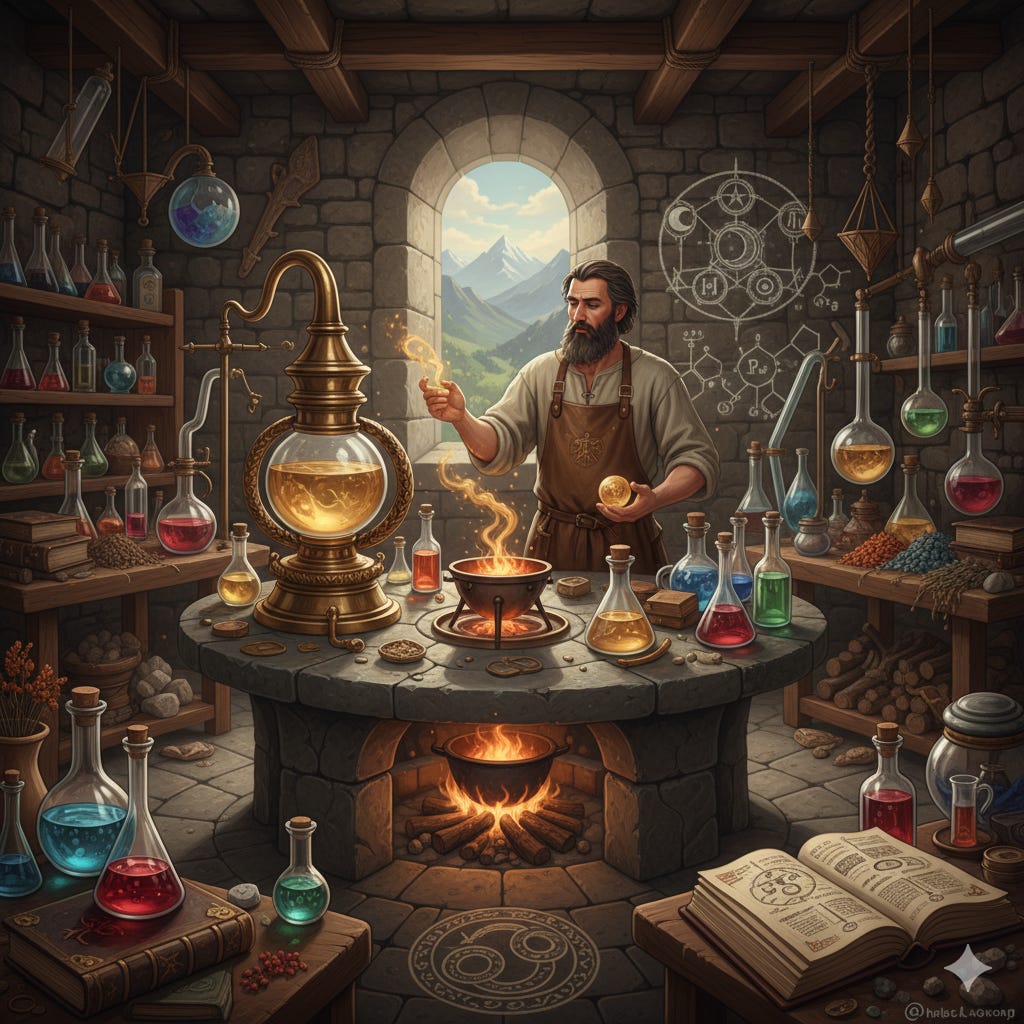
The Seven Stages of Becoming Human
Jung identified seven alchemical phenomena that most of experience during our lives:
conjunctio: the combining of contrary ingredients
solutio: a loss of one substance to create a new admixture
sublimatio: refining lesser ingredients into higher ones
coagulatio: turning something ephemeral into something concrete
calcinatio: the hardening needed to coalesce into substance
mortification: necessary dying for movement between stages
putrefactio: changing even to the point of appearing unattractive
Reading this list, you might notice that the first four sound almost... pleasant. Combining, refining, making concrete. But those last three? They sound like what life actually feels like when it's changing us.
When Life Becomes the Laboratory
Recently turning 60, I find myself living in those final phenomena. The last few years have been my own alchemical experiment: a painful divorce, running a business through COVID's chaos, selling that business and stumbling into 2nd half of life liminal space, and lastly, receiving a bladder cancer diagnosis and battling to get well.
None of this felt like transformation while I was in it. It felt like dismantling.
This reminds me of another Rohr insight that has stuck with me: profound growth comes through great love or great suffering. We'd all choose the love path if we could. But life, it seems, is a more practical alchemist. Some hardening, dying, and becoming temporarily unattractive to ourselves is par for the course.
Have you noticed this in your own life? How the changes that matter most rarely announce themselves as gifts?
The Courage to Stay in the Soup
Jung's genius was recognizing that the alchemists' search for gold was really a search for human wholeness. But here's the challenge Rohr identifies: we have to resist our ego's desperate need to control everything, which it loves to do.
Think of the caterpillar in its chrysalis. There's a stage where it's neither caterpillar nor butterfly—just soup. Undifferentiated cellular matter figuring out how to reorganize itself into something beautiful with wings. The caterpillar doesn't manage this process. It surrenders to it.
Our egos hate this stage. We want to skip the soup and get to the wings. We want to direct our own transformation, maintain some dignity in the process, maybe even look good while we're changing.
But what if the soupy liminal stage isn't a bug in the system—it's the feature?
What the Heart Knows That the Head Doesn't
The following excerpt from Rosemary Wahtola Trommer's poem seems to hit the mark:
"The heart understands swirl,
how the churning of opposite feelings
weaves through us like an insistent breeze
leads us wordlessly deeper into ourselves
blesses us with paradox
so we might walk more openly
into this world so rife with devastation,
this world so ripe with joy."
The heart understands swirl. While our minds want clear categories and linear progress, the heart knows how to hold contradictions. It can be broken and grateful simultaneously. It can grieve and hope in the same breath.
Maybe this is why the alchemists' literal experiments failed but their metaphor endures. They were onto something true about how change actually works—messy, mysterious, and requiring more trust than technique.
The Gold We Actually Find
At 60, having been through my own calcinatio, mortification and putrefactio stages, I'm starting to glimpse what the alchemists were really after. Not literal gold, but the kind of wholeness that can only come from having been thoroughly broken down and reassembled.
The divorce taught me about letting go of scripts I'd built my identity around. Cancer realigned my priorities with the knowledge that any day could be my last. Selling my business meant releasing control of something I'd poured years into building.
Each experience felt like dissolution. Each felt like a death. But now, on the other side, I can see the strange alchemy at work. The base metals of my various catastrophes are slowly revealing something that looks less like the life I planned and more like the life I might actually be meant to live.
What about you? What base metals is life asking you to work with right now? And can you trust the process even when it looks nothing like transformation?
I'd love to hear about your own alchemical moments in the comments—the times when life's laboratory produced something you never could have manufactured on your own.
May you have gratitude, may you have forgiveness, may you have love.
Ray
If this resonated, please share it with someone who might be in their own chrysalis stage. And subscribe for more reflections on the messy, mysterious business of becoming human.
Powerful Ray!
Love this! Alchemy as broken down by Jung reminds me of Rohr's "order, disorder, reorder" as a way to describe the cycle of human transformation & growth. Well said, Ray!